


Marius-Jean-Antonin Mercié (French, 1845–1916)
Gloria Victis (Glory of the Vanquished), modeled ca. 1874, cast after 1879
Bronze, 36 5/8 x 21 x 16 in.
Signed on base right: A. MERCIE. Inscribed on base at front edge: GLORIA VICTIS. Foundry mark on back base: F. BARBEDIENNE, Fondeur Paris. Stamped on back base: REDUCTION MECANIQUE A. COLLAS BREVETE.
Gift of Tracy and Laurel Pulvers
2014.3
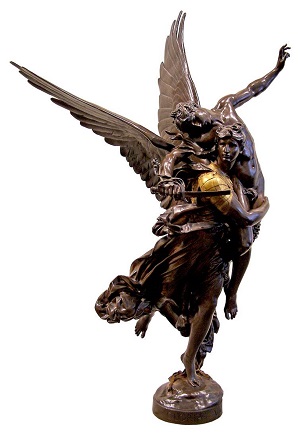
Although he was also a painter, Marius-Jean-Antonin Mercié is best known today as a prolific and celebrated sculptor. After training with François Jouffroy and Alexadre Falguière at the École des Beaux-Arts in Paris, Mercié won the Prix de Rome in sculpture in 1868 for his Theseus, Vanquisher of the Minotaur (École Nationale Supérieure des Beaux-Arts). While in Rome from 1868 to 1873, he completed plaster models for two of his most famous works: David (Salon of 1872) and Gloria Victis (Salon of 1874); both of which were highly acclaimed. Mercié began exhibiting paintings at the Salon in 1880 (winning medals in that medium in 1883 and 1889), but he did not give up on sculpture, for which he received a Medal of Honor at the 1878 Universal Exposition and Grand Prix at the Exposition of 1889. Mercié was also elected to the Institut de France in 1889, and in 1900 he was made a professor of drawing and sculpture at the École des Beaux-Arts as well as Grand Officer of the Legion of Honor. In 1913 he was named president of the Société des Artistes Français.
Mercié originally conceived Gloria Victis during the Franco-Prussian war, but after France’s defeat reworked what had been an allegory of victory to one of the vanquished. The winged female figure carrying a wounded soldier holding a broken sword expressed the loss and sacrifice of the French at the hands of the Prussians in the 1870–71 war. Exhibited at the Salon of 1874, the sculpture won critical and popular acclaim. In his review of the Salon that year, the critic Jules-Antoine Castagnary observed: “while monarchists quarrel over the debris of our battered fortunes…there exists a young sculptor who has undertaken to speak directly to our nation and to console our people who have suffered so much.” Mercié received a medal of honor for the work, the city of Paris purchased the sculpture for 12,000 francs, and the model was cast in bronze by Thiébaut et fils (Musée du Petit Palais, Paris). The city’s bronze cast was exhibited at the Salon of 1875 and the plaster version was re-exhibited at the 1878 Universal Exposition, where it was awarded a grand prize. Replicas of the work were dispersed across France. It adorned monuments dedicated to those who served in the Franco-Prussian War in many towns and cities, and the Barbedienne Foundry produced bronze reproductions in varying sizes.