COLLECTIONS & RESEARCH: OVERVIEW
The Dahesh Museum of Art collection contains paintings, drawings, prints, photographs, sculptures, and books by the most popular artists of 19th- and early 20th-century Europe. Artists such as Barye, Benouville, Bouguereau, Bonheur, Cabanel, Gérôme, Leighton, Picou, Troyon, and Vernet explored the subjects preferred by their fellow academicians, and by the growing middle-class audience who visited the annual Salons in Europe's major cities. Sumptuous landscapes, exotic "Oriental" scenes, closely observed animals, grandiloquent images from history and myth, and intimate scenes of everyday life form the core of the Museum's collection. Works by masters acclaimed today, and also by artists known only in their day, are viewed side-by-side, as they were 150 years ago. The Museum's permanent collection continues to grow with new acquisitions, gifts, and bequests, and the curators are happy to learn of works available for consideration.
Exploring the Collection
In this section, the Museum's curators present an in-depth look at one work of art in the permanent collection. Here Lisa Small explores why the Dahesh has embraced 19th-century academic art, the challenges of such an endeavor, and the aesthetic pleasure and intellectual insights that result.
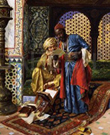
José Tapiró; Baró
Spanish, 1830-1913
A Tangerian Beauty, ca. 1876
Watercolor on paper, 26 x 18 1/2 in (66 x 47 cm)
Dahesh Museum of Art, 1995.117
Most accounts of 19th-century European art tell a selective tale of struggle and opposition, featuring artists who,
by rejecting the past, forged a seemingly inevitable path forward. This path led to modernism, a movement, style, and
belief system that dominated much of the 20th century, and that reduced to mere obstacles those artists and
institutionsbroadly known as academicthat did not follow its trajectory.
Today, modernism's staunchest adherents continue to protest that anyone seeking works of aesthetic merit or scholarly
value will find that academic art offers neither, and can only be regarded as an unfortunate footnote in art history.
While this position is founded on old assumptions, for many it remains unexamined, and is repeated as if it were the truth.
There is another story to tell about the 19th century. It does not perpetuate misleading dichotomies, but rather
acknowledges the complex practices, theories, and relationships that defined the art world in Europe, providing not
only a fuller appreciation of those academic artists whose work has been marginalized, but also a broader context
within which to understand the entire period.
A new generation of scholars and a growing public now understand that the history of art in the 19th century was a
unified one in which conservative and advanced artists interacted both in the academy and the marketplace. Eventually
today's art critical establishment will be forced to rethink their own, fundamentally arrière-guarde, views.
As the only institution in the United States devoted to Europe's academically trained artists of the 19th and early 20th
centuries, we are proud to offer a fresh appraisal of their works, and the fascinating tradition they epitomize. Through
exhibitions and programming, the Dahesh is mapping one of the most influential periods in art history, and, by linking it
to the present, we are able to deliver the pleasures of the past to an increasingly large and enthusiastic audience.
Back to top
|
"Academic art" refers to the tradition of drawing, painting, and sculpture taught at the academies, or art schools, of Europe. First established in Renaissance Italy, academies flourished in the 19th century and prescribed strict guidelines for the production of works of art. This organized training system ensured that artists possessed a high level of technical ability and familiarity with the lofty themes of the Western tradition. Nearly every city in Europe, and, later, the United States, Australia, and Latin America developed an art academy that set similarly high standards.
The most important academy of the modern period, and the one upon which many others modeled their own systems of promotion, patronage, display and teaching, was the French Academy, founded in 1648. During most of the 19th century, this powerful institution oversaw the premier art school in Paris, the École des Beaux-Arts, and controlled the official exhibitions known as Salons. It established a strict hierarchy for valuing subject matter, with history paintings at the pinnacle, and also awarded the most prestigious honor a French art student could receive, the prix de Rome.
|